From Serendipity to Intelligent Discovery of Molecular Glues


At a Glance
Over the past 7 years, we have built a powerful platform to intelligently discover molecular glues – overcoming several persistent bottlenecks for the field. With the recent addition of AlphaSeq 3D, we are uniquely positioned not only to discover and characterize novel effector-target interactions amenable to molecular glue modulation, but also to efficiently screen vast numbers of effector-target-molecule combinations for rapid and reliable glue discovery. In addition to successful partnerships with leading pharmaceutical companies, we’ve applied our platform internally to pursue targets of interest in oncology and immunology. For the first time, we have demonstrated a scalable, systematic approach to molecular glue discovery—one that moves beyond serendipity and enables rational exploration of entirely new effector–target interactions.
Challenges of Drugging the Undruggable
Induced proximity has redefined what is possible for targeting previously “undruggable” proteins. Among the various strategies, PROTACs (PROteolysis TArgeting Chimeras) have gained the most traction due to their relative ease of discovery. However, PROTACs are large, complex molecules that often come with poor pharmacokinetics and a potential risk of off-target effects.
Molecular glues have emerged as an attractive alternative strategy for targeting and degrading disease-relevant proteins. And yet, discovering molecular glues against novel protein pairs comes with its own set of significant challenges:
- The known universe of effector proteins for molecular glues is small, limiting their breadth and impact in drug discovery.
- It’s not clear which E3 ligase (or other effector) is compatible with a given target.
- It’s unknown if a potential glue will lead to a productive ternary complex that results in ubiquitination and degradation.
- Even with a compatible pair as a starting point, identifying functional molecular glues is rare.
These are the critical roadblocks we overcome at A-Alpha Bio. Instead of relying on serendipity, we have developed a high-throughput, intelligent approach to discovering molecular glues by starting with precision measurements of protein-protein interactions.
Expanding the Proximity Induction Universe
Despite the identification of hundreds of E3 ligases and other proximity-based effectors in the human proteome, only a small handful—like CRBN, VHL, and CypA—have been widely explored. This narrow focus has limited both the set of targetable proteins and the diversity of mechanisms available for molecular glue discovery.
At A-Alpha Bio, we address this limitation by systematically expanding the universe of validated effector proteins. Using our high-throughput AlphaSeq platform, we have built a proprietary library of nearly 400 effectors that show significant, specific interactions (in the 10nM – 1µM range) with at least one high-value target. This includes E3 ligases, chaperones, pan-essential proteins, and other potential effector proteins.
For those proteins that are challenging to express, we apply ML-guided protein engineering with our AlphaBind platform to identify stabilized constructs and functional truncations that recapitulate known binding. By combining experimental screening and predictive modeling, we unlock previously inaccessible effector proteins and dramatically expand the potential search space for molecular glues.
Identifying Compatible Ligase-Target Pairs
Molecular glues function by stabilizing existing, weak interactions between two proteins. Mechanistically, this makes sense—a molecular glue sits at the interface between two proteins, but the surrounding protein–protein contacts are critical for stabilizing the full ternary complex. Even in the absence of the small molecule, these contacts might still drive a weak (~10µM affinity) interaction. From a retrospective analysis, this is the case for serendipitously discovered glues, including the IMiDs.
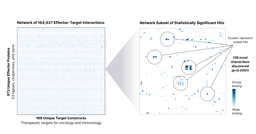
Screening for weak interactions between effectors and therapeutic targets can identify compatible pairs for molecular glues. But, doing so requires a platform capable of detecting mid-micromolar affinities at scale—something AlphaSeq is uniquely suited for. We measure hundreds of thousands of effector-target combinations simultaneously and detect weak but highly specific binding interactions. To uncover novel pairs, we measure binding between our effector library and two different target libraries:
- Rational Truncations: By generating multiple truncations and fusion orientations of each target protein, we increase the likelihood of identifying target variants that recapitulate correctly folded domains that act as structural neo-degrons.
- Scanning Peptides: By generating a library of overlapping peptides that cover the entire sequence of each target protein, we identify linear degron motifs with high positional precision—revealing interaction hotspots that serve as anchor points for glue design.
From internal screens, we find at least one weak but highly specific interaction for over 85% of the therapeutic targets tested. Outside of our own internal pipeline, we have successfully leveraged AlphaSeq in partnership with pharmaceutical companies (including Amgen and BMS) to find compatible pairs between their targets and our proprietary library of effector proteins.

Derisking Effector-Target Pairs Early
Even if a weak interaction exists between an effector and a target, it is often unclear whether there is a binding pocket for a glue, or whether a potential glue will stabilize a productive ternary complex to drive ubiquitination and degradation. We use AlphaSeq not just to discover effector–target pairs, but also to structurally and functionally de-risk them before investing in small molecule screening.
By screening mutagenic libraries of the target against the wild-type effector, we use AlphaSeq to identify mutations that strengthen or weaken binding—rapidly pinpointing the residues involved at the interface. Target mutants that show the strongest binding are then overexpressed and validated in cells. Using co-immunoprecipitation, ubiquitination, and degradation assays, we confirm that interactions are not only specific, but functionally productive when stabilized.
Applying the library-on-library capabilities of AlphaSeq together with our computational pipelines, infer residue-level proximity maps that inform structural modeling of the effector–target interface. We first use AlphaSeq to measure affinities between all single mutants of the effector against all single mutants of the target. These data allow us to identify residues across the interface that are in proximity – which are fed into a structural prediction model to generate a high-resolution structure of the bound proteins. This approach works reliably even when the interaction is far too weak for crystallography or computational docking. With these structural insights, we uncover glueable pockets and inform small molecule discovery.
Discovering Molecular Glues Intelligently and Reliably
Once we have expanded the potential search space of glueable interactions, identified compatible ligase–target pairs with latent affinity, and de-risked pairs by evaluating their structure and function, the collective data that we have generated for a novel pair helps tailor our approach to small molecule discovery and validation. For example, for effector-target pairs with clearly measurable affinity by SPR, we might use TR-FRET or ASMS for screening candidate glues; or for pairs that demonstrate cellular interactions, we might use DEL in-cell screening.
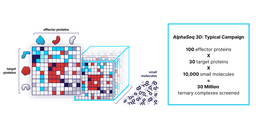
We also directly screen small molecules of interest against our derisked effector and target libraries using a new dimension of the AlphaSeq assay—AlphaSeq 3D. From one assay, we test thousands of small molecules against hundreds of pre-validated effectors and targets, providing high-sensitivity measurements for tens of millions of potential ternary complexes. This multiplexing capability puts us in a unique position to efficiently screen huge numbers of ligase-target-molecule combinations, dramatically increasing the hit rate for finding compounds that induce proximity.
Identifying molecular glues remains a fundamentally slow and unpredictable task in most discovery pipelines. At A-Alpha Bio, we have developed a systematic and scalable workflow to reliably discover molecular glues against diverse effector-target pairs.
Protein Degradation and Beyond
While targeted protein degradation is a clear and powerful application for molecular glues, our platform is fundamentally agnostic to effector function. The ability to measure and engineer weak protein–protein interactions—and to identify compounds that stabilize them—opens the door to broad applications of induced proximity therapeutics: protein sequestration, promotion of cell death, protein stabilization, and more. With A-Alpha Bio’s platforms, we can explore each of these effector functions systematically and broaden the impact of induced proximity therapeutics.
We are proud of our progress in developing a reliable molecular glue discovery platform and incredibly excited about the future of induced proximity therapeutics. We look forward to partnering with other industry leaders to innovate new, high-impact medicines and explore the potential of molecular glues as we move away from serendipity and toward intelligent discovery.
– David Younger and Randolph Lopez