One Innovation at a Time: Why we Built the Atlas Data Consortium


When we were starting A-Alpha Bio, a serial biotech founder gave us advice that stuck with us: build a company around a novel technology or a novel business model, but not both. Each one can become a durable advantage, but each also adds risk.
We chose the technology. AlphaSeq [1] was a genuinely new way to measure protein-protein interactions, and in 2018 it was entirely unproven outside the Institute for Protein Design. Knowing we were carrying that risk, we paired it with the most conventional business model that nearly every platform biotech runs: pipeline plus partnerships.
Eight years later, the technology has been soundly validated. With billions of interactions measured, AlphaSeq has been applied across many therapeutic programs, supported licensing decisions, and been used in multiple peer-reviewed studies authored by the A-Alpha team and with industry collaborators. We have also eliminated our pipeline. A-Alpha has no internal therapeutic programs; every experiment we run is in service of a partner or advancing our platform capabilities.
Having validated the technology, we can take on a second innovation. Now the place it is most needed is not in the lab but in changing the business incentives around how data is generated, shared, and used. It is time for a novel business model.
Data in pharmaceutical research is treated as a closely guarded asset, and where it concerns target biology or therapeutic sequences, it should be. That data is a company’s intellectual property and it is always going to be siloed.
However, there is a second category of “pre-competitive” data. Every therapeutics company would benefit from industry-wide advances in the quality, speed, and efficiency of drug development. Those gains are possible with AI protein engineering, whether the models are developed by the pharmaceutical company or accessed through licensing or partnership. Data with no connection to anyone’s proprietary programs, generated solely to make the underlying tools work better, is pre-competitive.
Pharma has always understood the distinction and has shared pre-competitive insights by publishing for as long as the industry has existed. While that ethos remains strong, it has never translated into sharing data at a scale that changes what models can learn.
The most serious attempts at sharing data have come through federated learning, where companies train shared models on their combined data without any of it leaving their control. The first real test of this approach was MELLODDY, a three-year project that included participation from 10 major pharma companies, as well as academic institutions [2]. Since then, numerous other federated learning initiatives have emerged. For example, Eli Lilly invited biotech partners to share their data through the TuneLab platform and the FAITE federated learning consortium has piloted models on biologics data from five pharma companies [3].
What no amount of pooling can do is make the underlying data larger. David Baker, who co-invented our AlphaSeq platform and serves on A-Alpha’s scientific advisory board, made the point the day after he won the Nobel Prize. The reason AlphaFold worked was because of the Protein Data Bank (PDB), a rare body of high-quality, curated, standardized data which barely exists for biology [4]. “It’s not just the methods, it’s the data.” Nearly two years later, the constraint remains, and the data volumes required to train generalizable protein models now exceed those available in the PDB.
“The next generation of AI-enabled drug discovery depends on training models with experimental data at a quality and a scale that does not currently exist.”
Christopher Austin, MD, SVP of R&D Technologies, GSK
So, we set out to make the second innovation.
The Atlas Data Consortium
The Atlas Data Consortium publicly launched in July with five founding members, including GSK, Boltz, Cradle, and Dyno Therapeutics.
Every quarter, each member designs one Data Block, a unit of one million protein-protein affinity measurements built around a machine-learning objective. A-Alpha designs additional Data Blocks each quarter alongside them, which scales as the Consortium grows. A-Alpha generates all data on the AlphaSeq platform under standard conditions, then pools and releases the resulting data quarterly to every member under a non-exclusive license (Figure 1).

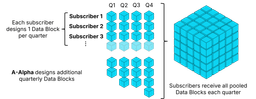
The first Atlas Data Consortium focuses on VHHs, the variable domains of heavy-chain-only antibodies. Because members use a shared scaffold, each Data Block a member designs is highly relevant to every other member’s models. Every member is attacking the same high-level problems: training models for generalizable de novo discovery and optimization of VHHs. Consortia focused on other scaffolds, like scFv/IgG, are expected to launch beginning in 2027.
No pharmaceutical or biotechnology company is going to share its pipeline targets or designs, and the Atlas Consortium does not ask them to. Proprietary work with A-Alpha runs on a separate track through Private Data Blocks, where the data is never shared with another company.
The Founding Members
The founding members span the range of organizations we think stand to gain most from eliminating their data bottleneck: GSK as a global biopharma leader driving discovery at scale with AI, Boltz and Cradle as model builders whose products are used across the industry for de novo design and antibody optimization, and Dyno Therapeutics as a company applying proprietary models directly in partnership with drug developers. Each of our founding members committed to a cooperative structure that had never been tried, before there was any track record to point to.
For some large pharmaceutical companies, the economics of generating platform data are genuinely difficult. First, a pharmaceutical company applies its models only to its own pipeline, which makes it hard to justify the cost of generating data at the scale generalizable models require when the resulting capability will only ever be used internally. Second, the industry has historically been more comfortable spending against a specific therapeutic asset than investing in general platforms that are harder to attribute directly to revenue. Both of these considerations are rational. Their business is making and selling medicines, not building drug discovery platforms. The result is that even companies with enormous research budgets and internal capabilities understand the need to generate as much data at scale as possible, resulting in the need to invest in many parallel efforts.
Model builders serving the whole industry face a different version of the problem. Their models are used by many companies against many pipelines, so every improvement in generalizable performance compounds across their entire customer base. They are also the group most exposed to the fact that architectural advantages tend to erode. Talent moves, methods get published, and approaches that were differentiating become standard, which is a pattern the AI field has watched play out repeatedly [5]. In biology, what a model is trained on is far harder to replicate. While many companies in this category are well funded, none are funded at the level needed to generate that volume of data alone.
Companies applying proprietary models in partnership sit differently again. Switching costs are higher than for a software product and there is more room to specialize, so the pressure is less about being compared head-to-head and more about what the models can actually deliver. Their economics are tied to the quality and success rate of the molecules they design rather than to software subscriptions, so better generalizable models improve both what they can offer and what they earn from it. A higher hit rate flows straight through to downstream value.
We expect more companies of each type to join. Each company brings a different perspective on what data is worth generating, and members have a great deal to learn from one another across those perspectives. Since all members of a given Consortium are focused on the same scaffold and on training generalizable models for binder design and optimization, we expect that design contributions and other learnings from each member will be valuable to all others even if their specific objectives are subtly different.
The Data the Field Actually Needs
More Data than Exists Today
The Protein Data Bank (PDB) contains roughly 11,000 antibody-containing structures with about 2,000 unique targets. Only around 2,000 are VHH complexes, and fewer than 800 entries are paired with quantitative affinity data. In recent years, the database has grown by about 1,000 antibody-antigen structures annually [6]. It also contains no negative binding data; by definition, structures are solved only for complexes that bind well enough to be experimentally resolved.
Our rough extrapolations place the data requirement for high-performing, generalizable de novo antibody design in the millions of antibody-antigen structures. For zero-shot optimization, we estimate that models need tens to hundreds of thousands of local affinity landscapes (Figure 2). Our SEPIA post and preprint address the structural requirement [6,7], and our team is preparing a companion analysis of affinity landscapes for publication later this year. Independent work has reached similar conclusions about the volume and diversity of data required for generalizable antibody-antigen prediction [8].

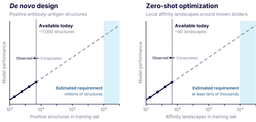
We may be wrong about exactly where the numbers land. We are confident about the order of magnitude, and it is far beyond what most of the field is planning for. Everything above describes a single scaffold on the two most tractable versions of the problem. Harder epitopes, and objectives like engineering pH sensitivity or dual specificity alongside affinity, will require more data still. Regardless of the headlines suggesting otherwise, the field is nowhere close to a wall where additional data stops contributing value; the opportunity to keep improving model performance through continuous data generation is enormous and largely untouched. Model architecture innovation will keep producing gains, though the evolutionary signal that carried the last decade of progress is closer to exhausted than the pace of model releases suggests [9].
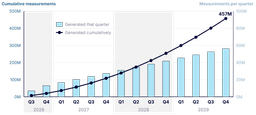
Federated learning is a strong start toward letting companies train on pooled datasets larger than any one of them owns. What it cannot do is add to the total. Even if every company in the industry pooled everything it had, the field would still be short by orders of magnitude, because the sheer volume of required data was never generated in the first place. The Consortium generates data at a scale that matters, and the scale grows with every member who joins (Figure 3). Christopher Austin at GSK described the Atlas Data Consortium as “a first-of-its-kind solution to help remove this bottleneck,” one that could potentially accelerate protein discovery at GSK while boosting innovation and collaboration across the industry.

Designed for Training, Not Repurposed
The data that already exists in the public domain was generated for other purposes: to advance a specific program, to answer a specific question, or to support a specific filing. None of it was designed to train a generalizable protein design model.
Consortium data is generated specifically for generalizable model training. Members help develop the roadmap and deliberately generate data for a defined AI objective, rather than relying on archives assembled for other purposes.
“High-quality, quantitative affinity datasets help models learn the principles that govern molecular function, enabling scientists to design and engineer better therapeutic proteins at every stage of development.”
Stef van Grieken, Co-Founder and CEO, Cradle
Designing forward also removes the barrier that has stopped most data-sharing efforts before they start, which is the unwillingness to hand over proprietary data that was never intended to leave the building. Every Data Block is designed by a member who chose to design it, knowing from the outset that the resulting data will be shared.
Note: Members who do not want to disclose their design strategy can ask A-Alpha Bio to design their quarterly Data Block on their behalf.
One Lab, One Protocol
Despite every scientist’s desire for ground truth, affinity is inherently context dependent. A reported affinity value reflects both the underlying interaction and the conditions under which it was measured, and those conditions vary across instruments, protein formats, buffers, and fitting assumptions. Randolph wrote recently about what it takes for an affinity measurement to work as a training label [10], and reproducibility within a single consistent assay context is crucial.
The failure mode when that requirement is not met is worse than random noise. In one recent study, a model could work out which chemist had made a molecule from its structure alone, and that single piece of information predicted biological activity about as well as the structure itself did [11]. A model trained on data aggregated across laboratories can learn to recognize the laboratory instead of the biology, and score well on held-out data while having learned nothing transferable.
Every Atlas Data Consortium experiment runs through AlphaSeq, A-Alpha Bio’s single experimental pipeline with consistent internal controls. This makes the resulting measurements quantitatively comparable and interoperable as the dataset grows into the billions.
“It’s a great sign of the field maturing to see companies increasingly focus on what they are the best in the world at, whether that is generating data, building models, or developing therapeutics. A-Alpha generates protein interaction data at a scale and quality very few can match, and that is exactly the kind of specialization that makes a consortium like this so powerful.”
Gabriele Corso, PhD, Co-Founder and CEO, Boltz
Consistency at that level requires a single operator, which concentrates a shared industry resource with one company. The reasonable question is: why should the field want that? Our answer is that the alternatives tend not to last. Shared resources built on philanthropy or public funding tend to start with real momentum and thin out when the money and attention move.
The Atlas Data Consortium is a business, and we think that is what makes it durable. A-Alpha’s incentive is to keep it running and growing for as long as the field needs it.
Data, Not a Model
Federated learning gives participants access to a shared trained model, not the underlying data. Everyone working seriously on AI protein engineering needs the same underlying measurements. What differs is what they do with them: different architectures, different objectives, different fine-tuning strategies, and different views on how binding should be represented. A single trained model produced by consensus forecloses all of that. It hands every participant the same answer to a question each of them wants to approach differently.
Gabriele Corso has framed what Boltz needs as access to “abundant and high-quality structural and affinity data” while they develop their models, which is very different from receiving a model somebody else has already trained.
Open to Everyone
In any structure built around pooling existing data, a participant’s contribution is largely determined by how much data it already holds. Companies with decades of accumulated data contribute disproportionately and therefore have little incentive to pool with smaller participants, who could receive the same value while contributing far less.
Prospective data generation removes the asymmetry. Each quarter, every member designs the same number of Data Blocks and receives all resulting data, regardless of the size of their existing data archive. A company founded eighteen months ago contributes exactly as much as one whose lineage runs back three hundred years, and receives exactly as much back.
Inclusivity matters here because most of the organizations that would benefit from generalizable biologics models are not large incumbents. Innovation in this field is happening across the entire ecosystem, and we do not think the world is better off if the most capable models, and the data behind them, accumulate only to the largest players.
Built for Collaboration
Collaboration is common in this industry, but it is almost always bilateral and transactional. Two parties negotiate and value is divided. The Atlas Data Consortium inverts that arithmetic. Members benefit when other members design Data Blocks that are maximally useful. This shared incentive encourages members to exchange lessons from experimental design, model failures, and the data needed to address those failures.
We have learned repeatedly, and sometimes painfully, that the difference between a good experiment and a great one is enormous, and that the skill of experimenal design compounds as data accumulates. Every quarter we understand a little better how to extract more value from a single Data Block. Five groups working on that question will learn faster than one group can. Fifty groups, spanning pharmaceutical research, model development, and molecular design, will find approaches that none of them would have reached alone.
“The Atlas Consortium’s datasets compound in scale and value with every experiment and every new member, creating a shared resource no single organization could build alone. This collaborative approach accelerates our work building AI technologies that bring genetic agency within reach for every patient.”
Eric Kelsic, PhD, Co-Founder and CEO, Dyno Therapeutics
Why It Matters
Antibody engineering remains slow and uncertain, especially for difficult targets. Generalizable models would change that, and the data those models require does not exist and will not realistically be created by any one company.
Creativity and innovation in this industry are distributed. They always have been. If only a small handful of organizations can afford the data that makes AI protein engineering work, the rest of the ecosystem loses the ability to compete on ideas, and the field gets narrower precisely when it should be widening. Making that data affordable and available to every company is how the tools stay in many hands.
Everything generated in the Atlas Data Consortium makes every member better at their work, and every member getting better makes the next round of data more valuable to everyone. That is true for a global pharmaceutical company, for a leading model builder, and for a rapidly growing biotech. This flywheel is just getting started, and we hope you will join us to accelerate the industry together.
– David Younger and Randolph Lopez
To learn more about our Atlas Data Consortia, visit atlas.aalphabio.com
References
[1] Younger D, Berger S, Baker D, et al. High-throughput characterization of protein–protein interactions by reprogramming yeast mating. Proc Natl Acad Sci 2017;114:12166–71. https://doi.org/10.1073/pnas.1705867114
[2] Heyndrickx W, Mervin L, Morawietz T, et al. MELLODDY: Cross-pharma Federated Learning at Unprecedented Scale Unlocks Benefits in QSAR without Compromising Proprietary Information. J Chem Inf Model 2024;64:2331–44. https://doi.org/10.1021/acs.jcim.3c00799
[3] Amsen E. Pharma learns to share as its AI demands more data. Chemical & Engineering News 2026. https://cen.acs.org/pharmaceuticals/drug-discovery/pharma-learns-share-ai-demands-more-data/104/web/2026/07
[4] Heikkilä M. A data bottleneck is holding AI science back, says new Nobel winner. MIT Technology Review 2024. https://www.technologyreview.com/2024/10/15/1105533/a-data-bottleneck-is-holding-ai-science-back-says-new-nobel-winner/
[5] LeSavage B. On Training Data for Bio AI Models. Dimension Research 2026. https://research.dimensioncap.com/p/on-training-data-for-bio-ai-models
[6] Harman J, Murakowska N, Noble D, et al. The Synthetic Epitope Atlas: Scaling Structural Training Data for De Novo Antibody Design. To Affinity And Beyond 2026. https://aalphabio.substack.com/p/the-synthetic-epitope-atlas-scaling
[7] Altieri N, Harman JL, Noble D, et al. The Synthetic Epitope Atlas: High-Throughput Design and Validation of De Novo Antibody-Antigen Complexes. bioRxiv 2026. https://doi.org/10.64898/2026.04.17.719295
[8] Hummer AM, Schneider C, Chinery L, et al. Investigating the volume and diversity of data needed for generalizable antibody–antigen ΔΔG prediction. Nat Comput Sci 2025;5:635–47. https://doi.org/10.1038/s43588-025-00823-8
[9] Outeiral C. Coevolution took us here, but it’s not enough. 2026. https://couteiral.substack.com/p/coevolution-took-us-here-but-its
[10] Lopez R. AlphaSeq: Turning Binding Measurements into Training Data. To Affinity And Beyond 2026. https://aalphabio.substack.com/p/alphaseq-turning-binding-measurements
[11] Blevins AD, Quigley IK. Clever Hans in Chemistry: Chemist Style Signals Confound Activity Prediction on Public Benchmarks. arXiv 2025. https://arxiv.org/abs/2512.20924